Search Algorithms
Search is the process of finding a sequence of actions that achieves a goal in a given environment. It's fundamental to intelligent-agent problem-solving.
Problem Formulation
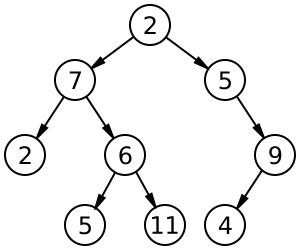 A tree structure showing how search algorithms explore the state space. Root is initial state, branches show possible actions, leaves are goal states.
Every search problem requires: - Initial state: Where the agent starts - Actions/Operators: Available moves in each state - Transition model: Result of applying an action - Goal test: Condition(ing that identifies goal states - Path cost: Cost of each action (usually 1, but can vary)
Search Space Concepts
- State space: The set of all possible states reachable from initial state
- Search tree: Tree representation of paths from initial state
- Search graph: State space represented as a graph (with cycles/revisits handled)
Uninformed Search Strategies
Blind search with no domain knowledge. Characterized by: - Completeness: Does it find a solution if one exists? - Optimality: Does it find the minimum-cost solution? - Time complexity: Grows with branch factor $b$ and depth $d$ - Space complexity: Memory required
Key Uninformed Algorithms
| Algorithm | Complete? | Optimal? | Time | Space | Notes |
|---|---|---|---|---|---|
| BFS | Yes | Yes (if cost=1) | $O(b^d)$ | $O(b^d)$ | Exponential memory |
| DFS | No | No | $O(b^m)$ | $O(bm)$ | m=max depth |
| IDDFS | Yes | Yes | $O(b^d)$ | $O(bd)$ | Best uninformed |
| Uniform-cost | Yes | Yes | $O(b^{C*/\epsilon})$ | Exponential | Handles varying costs |
BFS (Breadth-First Search)
- Expand shallowest nodes first
- Uses FIFO queue
- Complete and optimal for unit-cost problems
- Memory-intensive: stores all nodes at frontier
DFS (Depth-First Search)
- Expand deepest nodes first
- Uses LIFO stack
- Space-efficient but can get lost in infinite branches
- Not guaranteed to find optimal solution
IDDFS (Iterative Deepening Depth-First Search)
- Combines DFS space-efficiency with BFS completeness
- Repeats DFS with increasing depth limits
- Asymptotically same complexity as BFS, better memory
- Preferred uninformed strategy
Informed (Heuristic) Search
Uses domain knowledge to guide search via heuristic function $h(n)$ = estimated cost to goal.
A* Search
- Most important algorithm in AI
- Evaluation function: $f(n) = g(n) + h(n)$
- $g(n)$ = actual cost from start to $n$
- $h(n)$ = heuristic estimate from $n$ to goal
- Optimal if heuristic is admissible
- Most efficient if heuristic is consistent
- Expands fewest nodes among optimal algorithms
Admissibility & Consistency
- Admissible: $h(n) \leq h^*(n)$ for all $n$ (never overestimates)
- Consistent: $h(n) \leq c(n,a,n') + h(n')$ (triangle inequality)
- Consistency implies admissibility
Heuristic Generation
Sources of good heuristics: - Relaxed problems: Remove constraints - Pattern databases: Precomputed optimal solutions to subproblems - Learning: Machine learning from experience
Local Search
For problems where path doesn't matter, only final solution:
- Hill climbing: Greedy, get stuck in local maxima
- Simulated annealing: Probabilistic, escape local optima
- Genetic algorithms: Population-based evolution
- Beam search: Keep k best nodes
Beyond Classical Search
- Nondeterministic environments: AND-OR-Search
- Partial observability: Belief states, sensorless problems
- Online search: No model, learn environment online (LRTA*)
Related Concepts
- Problem-Solving — Framework for using search
- Planning — High-level search in action space
- Game-Playing — Adversarial search (Minimax, Alpha-Beta-Pruning)
- Constraint-Satisfaction — Specialized search for CSPs
References
Russell & Norvig (2010): Chapters 3-4