AI Architecture Evolution: 2022-2026
The journey from text-only models to multi-modal, thinking-enhanced, and specialized architectures.
Timeline Overview
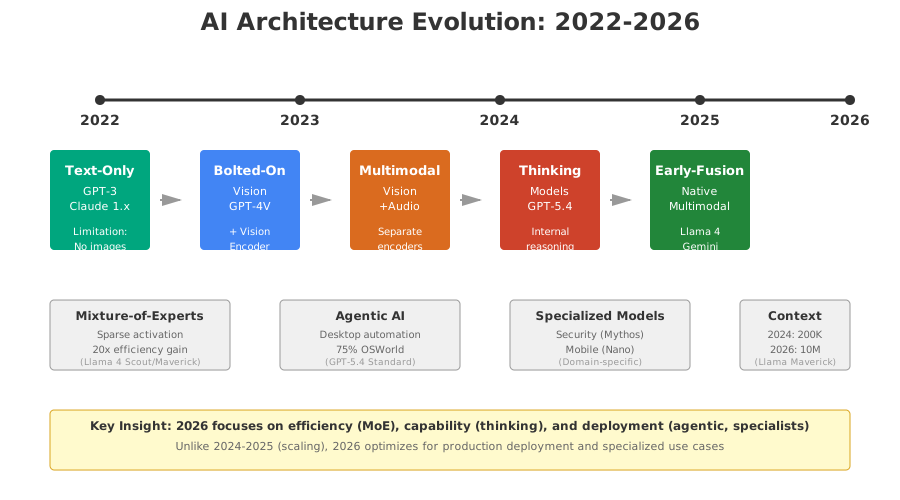 Key innovations in AI architecture development
Era 1: Text-Only (2022)
Characteristics
- Models: GPT-3, Claude 1.x, others
- Input: Text only
- Capability: Language understanding and generation
- Limitation: No vision, no images
Impact
- Foundation of modern LLMs
- Established transformer architecture dominance
- Demonstrated scale-drives-capability principle
Era 2: Bolted-On Vision (2023)
Characteristics
- Models: GPT-4V, Claude with vision, Gemini Preview
- Approach: Separate vision encoder + text model
- Input: Text + images (in parallel)
- Limitation: Weak cross-modal understanding
Architecture
Image → [Vision Encoder] ─┐
                         ├─→ [Concatenate] → [LLM]
Text ─────────────────┘
Problem
- Vision treated as auxiliary
- Image not deeply integrated into reasoning
- Separate encoders complicate inference
Era 3: Multimodal (2024-Early 2025)
Characteristics
- Models: Gemini 2.5, Claude 3.5
- Approach: Enhanced encoders, cross-attention
- Input: Text, images, audio
- Improvement: Better cross-modal reasoning
Architecture
Image → [Vision Encoder] ──┐
Audio → [Audio Encoder] ───├─→ [Cross-Attention] → [LLM]
Text ──────────────────────┘
Achievement
- Better image understanding
- Audio support added
- But still separate encoders
Era 4: Thinking Models (2025-2026)
Characteristics
- Models: GPT-5.4 Thinking, Gemini 3.1 native thinking
- Innovation: Internal reasoning before output
- Benefit: Better reasoning on hard problems (+3-5% on benchmarks)
- Cost: 5-20x slower, 2-3x more expensive
Architecture
Prompt → [Thinking Phase] → [Output Phase] → Response
         (internal)        (external)
Achievement
- AIME 2025: 95.6% (Gemini), 93.8% (GPT Thinking)
- Better on complex reasoning tasks
- Transparent reasoning available
Era 5: Early-Fusion Multimodal (2026)
Characteristics
- Models: Llama 4, Gemini 3.1
- Innovation: Interleaved tokens from training inception
- Input: Text, images, video — all native
- Benefit: Deep cross-modal understanding
Architecture
Training data (interleaved):
  <image> {image_tokens}
  "The cat is..."
  <video> {frame_tokens}
  "Playing in the yard"
Achievement
- Native multimodal understanding
- Better spatial reasoning
- Video ingest (up to 45 minutes)
- 10M token context (Llama Maverick)
Parallel Innovations (2025-2026)
1. Mixture-of-Experts (MoE)
- Introduced: Llama 4 (2026)
- Benefit: 20x efficiency without capability loss
- How: Sparse activation (17B of 400B active)
- Impact: Enables frontier AI on single GPU
2. Agentic AI
- Introduced: GPT-5.4 Standard (2025)
- Capability: Desktop/web automation
- Score: 75% on OSWorld benchmark
- Impact: Enables autonomous business processes
3. Specialized Models
- Claude Mythos: Security specialist (red-teaming)
- Nano Banana 2: On-device mobile AI
- Domain models: Medical, legal, code-specific
- Impact: Expertise depth over generalization
Key Trends
Trend 1: From Monolithic to Specialized
- 2022-2024: Single general-purpose model
- 2025-2026: Suite of specialized variants
- Future: Expert model markets
Trend 2: From Bolted-On to Native
- 2023: Separate encoders for modalities
- 2024: Cross-attention improvements
- 2026: Early-fusion training from inception
- Future: Unified sensory understanding
Trend 3: From Fast Inference to Thoughtful Response
- 2022-2024: Speed-optimized
- 2025: Thinking models (accept latency for quality)
- 2026: Balanced approach (multiple variants)
- Future: Adaptive reasoning (think when needed)
Trend 4: From Centralized to Distributed
- 2022-2024: Cloud-only APIs
- 2025: On-premises options (Llama)
- 2026: On-device deployment (Nano)
- Future: Federated specialist networks
Trend 5: From Dense to Sparse
- 2022-2024: All parameters always active
- 2025-2026: Mixture-of-Experts (selective activation)
- Future: Hierarchical sparsity
The 2026 Landscape
Current Positioning
| Model | Strength | Architecture |
|---|---|---|
| Gemini 3.1 | Intelligence + multimodal | Early-fusion, thinking-native |
| GPT-5.4 | Agentic + reasoning | Dense, with thinking variant |
| Claude 4.6 | Safety + reasoning | Text-focused, enhanced cross-attention |
| Llama 4 | Efficiency + open-source | Early-fusion, MoE sparse |
Capability Frontier
2022: Text ──────────────────────
2023: Text + Image ──────────────
2024: Text + Image + Audio ──────
2026: Text + Image + Audio + Video + Reasoning + Agentic
      + Specialized + On-device + Thinking
What Changed Most
2022 → 2026 Comparison
| Aspect | 2022 | 2026 | Change |
|---|---|---|---|
| Modalities | Text only | 5+ modalities | Massive |
| Context | 4K tokens | 10M tokens | 2,500x |
| Reasoning | Direct | Explicit thinking | New |
| Capability | General | General + specialized | Differentiation |
| Deployment | API only | API + on-prem + device | Distributed |
| Efficiency | Dense | Sparse (MoE) | 20x gain |
| Cost | Premium | Free to premium | Options |
Lessons Learned
From 2022-2026 Evolution
- Scale isn't everything anymore
- 2022-2024: More params = better
- 2025-2026: Efficiency + specialization matter more
-
Llama 4 Scout (109B) competes with 405B dense models
-
Reasoning requires deliberation
- Thinking models (+3-5% on hard problems)
- Worth the latency for complex tasks
-
Changing how we think about inference
-
Modality integration > addition
- Bolted-on vision ≠ native multimodal
- Early-fusion from inception superior
-
Affects training, not just inference
-
One size doesn't fit all
- General models losing to specialists
- Domain-specific knowledge value increasing
-
Emergence of variant suites (Mini, Opus, Haiku)
-
Open source accelerates progress
- Llama 4 competitive with proprietary
- Enables on-premises deployment
- Cost equation fundamentally shifted
Future Directions (2027+)
Predicted Innovations
- Multi-Agent Reasoning
- Agents cooperating internally
- Specialized agents for tasks
-
Emergent capabilities
-
Adaptive Computation
- Models decide when to think
- Dynamic resource allocation
-
Efficiency optimization
-
Federated Specialization
- Transfer between domains
- Expert composition dynamically
-
On-demand capability assembly
-
Sensory Integration
- Beyond text/image/audio
- Simulation/synthetic senses
-
Olfactory/proprioceptive simulation
-
Embodied AI
- Models with world models
- Robot integration
- Physical task simulation
The Big Picture
2022: "How big can we make it?"
2024: "What can it do?"
2026: "How efficient and specialized can it be?"
2028+: "How intelligent and adaptive can it be?"
The frontier keeps moving — from scale to capability to efficiency to adaptation.
Last Updated
April 8, 2026